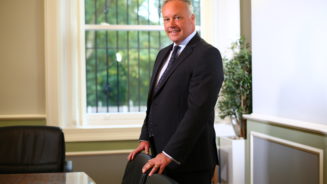
Having spent 20 years with Goldman Sachs Asset Management, Suneil Mahindru was running a global financials fund when the economic crisis erupted in 2007 and Lehman Brothers filed for bankruptcy in September the following year.
He recollects how at that time “no one, understandably, wanted to invest in financials”, and with Goldman Sachs also in the spotlight, he discovered two things that helped him navigate his way through this challenging time.
The first of these was his family. “I had young kids, and they were the only thing that kept me sane. I would go home and say to my wife, ‘The world could end tomorrow’, and the kids would say, ‘Come on then, let’s go and play in the garden’. They had no context, so that was great.”
Core strategy
The second was his investment strategy, which was focused around core investments that he would want to own over an extended period of time.
“We definitely were not imagining a global financial crisis on that scale but, if you own good businesses, they will survive. So that is what we focused on.”
Fast forward to today, as the lead portfolio manager for the Goldman Sachs Global Equity Partners Portfolio, a sub-fund of the firm’s Luxembourg-domiciled Sicav, is the approach he adopts Warren Buffet-style?
No it is not, he says. “Our fund may not be quite as well known as Warren Buffet’s but the annualised turnover over the past four years is 23%. We do not target a low turnover but it is a reality of what we are trying to do. We want to buy businesses that we can own for the long term but this does not mean they are not cyclical.”
Quality key
For Mahindru, the quality of the business is very important, but equally so is its price tag. “What tends to get us either in or out of businesses is how much we are paying for the quality of the business.
“Once everyone else works out that it is a wonderful business and they are paying up for it, then often that is the time when we are going to exit.”
He puts a particular emphasis on number crunching, which stems from his time covering the financial sector. “You do not even have to tell me what the business is. Let’s look at the numbers and see what they show.”
When it comes to sourcing a particular stock, one advantage he has in common with other larger asset managers is a global network of people on the ground. Goldman Sachs has 90 such analysts.
“That is important because it means you are sourcing ideas and you are not reliant on an industry which does a fair job pushing ideas that are the most obvious.”
Turning to asset allocation, he makes two points, the first being that he is not trying to time markets as there is simply not a good probability of getting it right, hence the portfolio is fully invested.
“Second, if we think of what our clients want us to do, they use the fund for exposure to the equity market. They can do the asset allocation themselves.”
As well as being low turnover, the portfolio is concentrated and very bottom-up.