
Rather than taking place within individual Budget cycles, UK tax reforms are being phased in over several years, with changes extending from 2024 through to 2031. This evolving landscape makes long-term wealth planning, succession planning and tax-efficient investment management increasingly important.
To help advisers understand the scale and timing of these developments, Simon Martin, Head of UK Technical Services at Utmost, and the wider Utmost Technical team have created a comprehensive timeline mapping the key changes announced across the 2024, 2025 and 2026 UK Budgets.
Their analysis highlights why advisers should consider these reforms as a connected programme of tax change, rather than a series of isolated Budget announcements.

In this article:
- UK Budget changes from 2024 to 2031
- Why long-term wealth planning is becoming increasingly important
- Investment bonds and tax-efficient investment management
- Estate planning, inheritance tax and trusts
- Looking beyond the next UK Budget
- UK Budget resources for financial advisers
UK Budget changes: A timeline of tax reforms from 2024 to 2031
The UK tax landscape is undergoing significant change, with reforms affecting capital gains tax, inheritance tax, pensions, property income, trusts and salary sacrifice arrangements.
Understanding the timeline is essential for advisers helping clients make informed wealth planning and estate planning decisions.
The key changes include:
October 2024: Capital gains tax and inheritance tax changes
Capital gains tax rates increased in October 2024, alongside immediate changes to the inheritance tax treatment of certain excluded property trusts.
These reforms marked the beginning of a wider programme of changes affecting how individuals structure and manage their wealth.
April 2025: Changes to inheritance tax and the FIG regime
April 2025 introduced two significant developments for internationally mobile individuals and those undertaking succession planning.
The UK moved from a domicile-based inheritance tax system to a residence-based regime, while the Foreign Income and Gains (FIG) framework was introduced.
These changes brought new considerations for individuals with international connections and advisers reviewing existing estate planning arrangements.

April 2026: Agricultural Property Relief, Business Relief and dividend taxation
Further UK Budget changes took effect in April 2026, including restrictions to Agricultural Property Relief and Business Relief.
Dividend tax rates also increased, alongside limits affecting certain excluded property trusts.
For clients with business interests, agricultural assets and trust arrangements, these developments create additional considerations when reviewing wealth preservation and succession strategies.
April 2027: Inheritance tax on unused pension funds
One of the most significant forthcoming changes is the introduction of inheritance tax on unused pension death benefits from April 2027.
This represents an important shift for affluent families who have historically viewed pensions as an efficient vehicle for passing wealth between generations.
Alongside this change, savings income and property income tax rates are also set to increase.
2028: End of the Temporary Repatriation Facility
The Temporary Repatriation Facility is scheduled to end in 2028, creating another important milestone for internationally connected clients reviewing their financial and tax planning arrangements.

2029: Changes to pension salary sacrifice
Changes to pension salary sacrifice arrangements are scheduled for 2029, adding another consideration for individuals and advisers reviewing pension contributions and longer-term financial planning.
April 2031: Extended freeze on income tax and inheritance tax thresholds
Income tax and inheritance tax thresholds remain frozen until April 2031.
This prolonged freeze creates continued exposure to fiscal drag, potentially bringing more individuals and their assets into higher tax liabilities over time.
Why long-term wealth planning is becoming increasingly important
The staggered introduction of UK Budget reforms means that advisers can no longer focus solely on the next Budget announcement.
Long-term wealth planning is becoming increasingly important as clients navigate changes that will affect their financial arrangements over several years.
According to Utmost’s UK Technical specialists, understanding when tax changes take effect is just as important as understanding what those changes mean.
The transitional periods between reforms may provide opportunities for advisers and their clients to:
- Review existing succession and estate planning strategies.
- Assess the suitability of current trust structures.
- Consider available tax reliefs before legislative changes take effect.
- Review how assets are held and positioned for future generations.
- Reconsider the role of pensions and alternative investment structures in wealth transfer strategies.
The introduction of inheritance tax on unused pension funds from April 2027 is particularly significant. Families who have traditionally used pensions as a wealth transfer vehicle may need to reconsider how their wider estate is structured.
As the tax rules evolve, alternative investment wrappers and broader estate planning strategies are likely to receive greater attention.

Investment bonds and tax-efficient investment management
As UK tax rates increase and allowances remain frozen, the structure through which wealth is held and invested is becoming increasingly important.
Tax-efficient investment management is an important consideration for advisers navigating changes to savings income, rental income, trust taxation and inheritance tax.
Investment bonds continue to feature in many wealth planning discussions, particularly where clients are looking for a combination of tax efficiency, flexibility and long-term investment management.
According to Utmost’s Technical team, investment bonds can offer a number of features relevant to these discussions, including:
- Gross roll-up: Investment growth within the bond is not generally subject to UK income tax or capital gains tax as it arises, subject to the applicable tax rules.
- Flexible withdrawals: Clients can access their investments through withdrawals, with the tax treatment depending on the circumstances and applicable rules.
- Simplified administration: Investment bonds can provide a straightforward structure for managing investments.
- Long-term flexibility: Their features can support changing wealth planning requirements as clients’ circumstances and tax legislation evolve.
Investment bonds are therefore one of the structures advisers may wish to consider when reviewing clients’ wider wealth planning and estate planning arrangements.
The suitability of any investment structure will depend on individual circumstances, objectives and tax considerations.

Estate planning, inheritance tax and the changing role of trusts
Inheritance tax reform is creating additional complexity for families looking to preserve wealth and pass assets to future generations.
Changes to the residence-based inheritance tax regime, excluded property trusts, Agricultural Property Relief and Business Relief all reinforce the importance of regularly reviewing estate planning arrangements.
The forthcoming inheritance tax changes affecting unused pension funds from April 2027 add another layer of complexity.
For advisers, this means taking a broader view of how clients’ wealth is structured, including the interaction between pensions, trusts, investment bonds and other assets.
Rather than treating each asset or investment in isolation, a coordinated approach to estate planning can help ensure that wealth transfer strategies remain appropriate as the legislative landscape evolves.
Looking beyond the next UK Budget
The most important message from Utmost’s UK Budget timeline is that tax planning needs to take a longer-term view.
Many of the most significant reforms will not take effect for several years. However, decisions made today could have a lasting impact on how successfully clients navigate those changes.
By understanding the UK tax reform timeline, advisers can help clients identify planning opportunities, review existing arrangements and consider how their wealth should be structured for the future.
As the UK moves through this extended period of tax reform, knowing not only what is changing but when those changes take effect could prove just as valuable as the planning strategies themselves.
UK Budget resources for financial advisers
To help advisers navigate the changing UK tax landscape, the Utmost Technical team has developed three resources providing further information, analysis and practical reference material.
Download the resources below:
1. UK Budget timeline
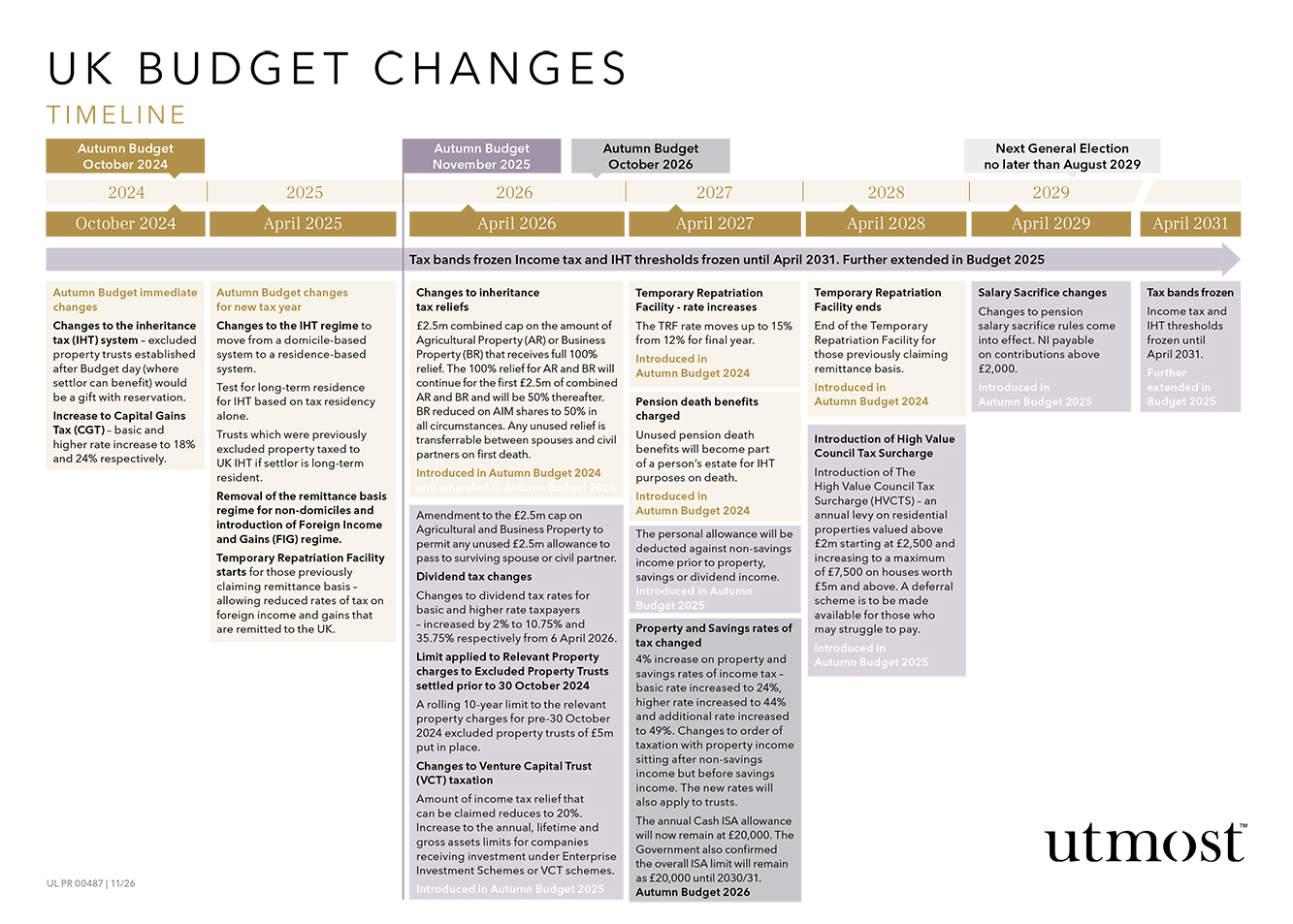
A timeline of key UK tax changes announced across the 2024, 2025 and 2026 Budgets, highlighting when reforms take effect through to 2031.
Download the UK Budget timeline
2. UK Budget commentary

Further technical insight and commentary from the Utmost Technical team on the latest UK Budget announcements and their implications for wealth planning.
Download the UK Budget commentary
3. UK Tax Tables 2027/28
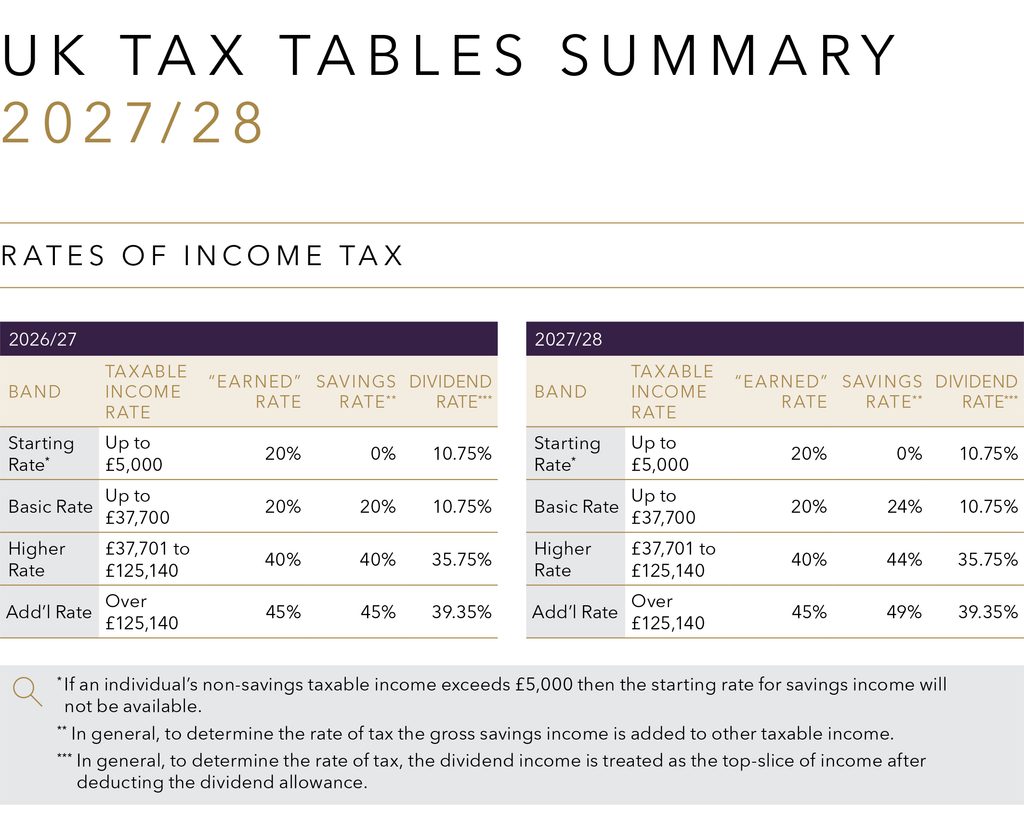
A useful reference resource for advisers looking to understand UK tax rates, allowances and thresholds for the 2027/28 tax year.
Download the UK Tax Tables 2027/28
Explore more technical insights from Utmost and help your clients plan with confidence as the UK tax landscape evolves.
Written by Beth Brearley, Journalist at International Adviser